

The moon looms large in the night sky—and in children’s imaginations.
At the Twinbrook Library in Rockville, Maryland, Theresa Schneider, the head of children’s services, loves connecting with that sense of wonder. Books that feature the moon appear frequently at pajama storytimes and other family programs at her Montgomery County branch. One of her childhood favorites—”Goodnight Moon”—is also beloved by young patrons.
The secret to the book’s staying power? The incantatory text and “dream-like illustrations beautifully capture that rather surreal transition from daytime to sleep,” she said
Those looking for a read-aloud “perfect for snuggling” might check out the popular “Guess How Much I Love You.” For Schneider, the final line “I love you right up to the moon AND BACK,” tenderly conveys the power of the parent/child bond.
She also recommends two Caldecott winners, the sweet and silly “Kitten’s First Full Moon” and the lyrical “Owl Moon.” And for a lively nonfiction treatment pitched to little ones, try “The Moon Book.”
Are your kids intrigued by the moon? You might add these recently published titles to Schneider’s classics.
Tots-age 7
“Moon! Earth’s Best Friend”

By Stacy McNulty
Illustrated by Stevie Lewis
Henry Holt, 2019, $17.99
In this animated, first-person narrative, the moon positions herself as Earth’s very helpful friend—for more than 4.5 billion years. Important facts are engagingly presented. She is a satellite, meaning she circles the Earth. Her gravity keeps our planet from being “too wobbly” and creates the tides. What will you find on the moon? Mostly rocks—but also “stuff left behind by untidy astronauts”: nail clippers, a golf ball, an American flag. This playful book enhances a child’s understanding of the faraway, mysterious moon.
“The Moon Inside”
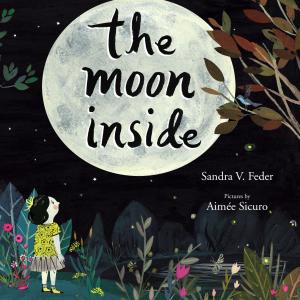
By Sandra Feder
Illustrated by Aimee Sicuro
Groundwood, 2016, $17.95
Bedtime can be full of emotions for many youngsters. There is separation from parents, fear of missing out, the act of losing oneself to sleep. What might darkness hold and hide? For most kids, the moon is the obvious symbol of night. This gentle story explores a child’s fears, with Ella turning on lights each evening “to make the dark go away.” But one night, her mother takes her outside. Ella focuses on the glowing moon, dancing fireflies, soft chirp of crickets, the rustle of trees. Through such careful attention, Ella begins to lose her fears and to appreciate this serene energy. The mixed media art reinforces this mood, through a palette of black, white, soft grays and yellow. The measured pacing and soothing language make this a perfect bedtime choice for wide-awake youngsters.
Preteens
“All Four Quarters of the Moon”

By Shirley Marr
Simon and Schuster, 2022, $17.99
This quietly compelling novel covers a year in the life of the Guo family, from the Mid-Autumn Festival, with mooncakes, in Singapore to that same festival in Australia. With her parents struggling to adjust to their new country and her grandmother losing her memory, 11-year-old Peijing shoulders responsibilities beyond her years. And to compound her challenges, she often must watch her rambunctious, imaginative 5-year-old sister, Biju. Each chapter begins with a short Chinese folktale re-told by Biju. Like many kids, though, she re-casts the tales to reflect her version of her family and their situation. This gives Peijing and the reader additional insight into family dynamics and their Chinese heritage. As this touching story unfolds, Peijing begins to understand how people (and life) can change and still remain constant. As she reflects: “The moon always looked different when you looked at it, but it was still the same moon.”
“Luna: The Stories and Science of Our Moon”

By David Aguilar
National Geographic Kids, 2019, $17.99
Want to take a trip to the moon, through space and time? This far-ranging, visually appealing book considers our luminous orb through the lens of science, history and folklore. Each double-page spread—illustrated with photos and graphics—explores a specific topic, such as “Moon Myths” or “Lunar Eclipses.” And well-explained activities add to the learning and fun, including creating a model of the moon.
Teens
“How We Got to the Moon”
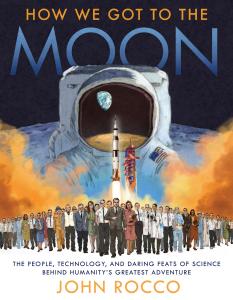
By John Rocco
Crown, 2020, $29.99
This fascinating compendium of “the people, technology and daring feats of science” behind the first moon landing in 1969 won a prestigious Sibert Honor for nonfiction. The book begins in 1957, with the launching by the Russians of the first artificial satellite, Sputnik. Space is a new frontier, with the United States soon spurring innovation in spacecraft and spacesuit design. How were astronauts trained and chosen? How was the moon landing televised? And how did physiologist Rita Rapp provide Apollo 8 astronauts with turkey and cranberry sauce for Christmas in 1968? These questions and more are answered in this expansive, beautifully researched tome.

Mary Quattlebaum lives in Washington, D.C. and is the author of 30 award-winning children’s books, most recently Queen Elizabeth II, an early reader biography. She teaches in the graduate program in writing for children at the Vermont College of Fine Arts, writes frequently for The Washington Post and is a popular school and conference speaker. maryquattlebaum.com
Mary Quattlebaum lives in Washington, D.C. and is the author of 30 award-winning children’s books, most recently Queen Elizabeth II, an early reader biography. She teaches in the graduate program in writing for children at the Vermont College of Fine Arts, writes frequently for The Washington Post and is a popular school and conference speaker. maryquattlebaum.com

